
DeepUndress
Four NSFW image workflows on one account: photo undress, pose regeneration, face swap, and short video generation from a shared credit pool.
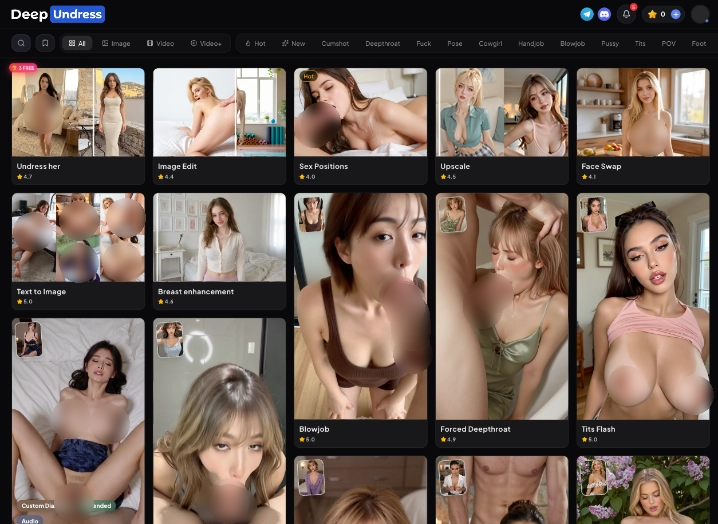
Deep Undress across four workflows
The Deep Undress feature list on the landing page names four separate NSFW image tools before anything else: photo undress, pose regeneration, face swap, and short video generation. Almost every competitor in this directory picks one of these lanes and stays there. Deep Undress puts all four inside a single account, drawing from a shared credit balance the platform calls stars.
The setup matters because the four modes are used together in practice, not separately. A user who runs a photo undress often wants to correct the face afterward, regenerate the subject in a different pose, or animate the final result. Splitting those steps across four separate services quadruples the friction and forces the buyer to maintain multiple accounts. Deep Undress removes that overhead by design.
The service lives at deepundress.app and runs entirely in the browser. There is no native mobile app, no desktop client, and no download step. Users interact with the four modes from a single dashboard, and any generation from one mode can be piped as input into another without exporting and re-uploading. That interoperability is the actual selling point.
The undress workflow and what shapes output quality
The undress side of Deep Undress is the anchor workflow and the one most first-time visitors are testing. Users upload a photo, the platform’s model detects clothing regions, and the output arrives as a nude-transformed version of the same subject. Turnaround on standard inputs is fast enough to keep an iterative testing session responsive.
Output quality on Deep Undress follows the same rules as every automated-detection undress tool in the category: cleaner inputs produce cleaner results. Frontal shots with even lighting land at the top of the quality curve. Group photos, layered clothing, oblique angles, and heavy shadows are where any detection-based model shows its limits. This is not a criticism of the platform specifically, it is a category-wide constraint that applies to PornWorks, Clothoff, and every other detection-based tool in the same class.
Where Deep Undress differentiates from the pure-undress category is that the pipeline does not stop at the removal step. The same generation can be followed immediately by a pose regeneration in a specific position, or by a face swap if the detection produced an inconsistency around the identity area. That in-platform chaining is what the shared-credit design actually enables.
The position and pose preset library
Alongside the standard undress function, Deep Undress ships a named library of pose and position presets. These regenerate the subject in a specific scenario rather than removing clothing from the original pose. Users pick a preset from the interface and the model rebuilds the composition around it while preserving the identity signals from the source photo.
The library gives users a shortcut around the biggest limitation of pure undress tools: the output pose is fixed by the input pose. If the source photo has the subject sitting, the raw undress output also has them sitting. The Deep Undress pose engine breaks that constraint by feeding the identity-preserving elements of the source into a scenario generator that produces a fresh composition. That is genuinely useful for anyone who wants variation beyond simple clothing removal.
Users should treat the preset library as a starting point rather than an infinite customization surface. Named positions produce named outputs. There is no free-form prompt field for pose descriptions in the way a prompt-based generator would offer. What the platform gives up in prompt flexibility it gains in reliability: preset outputs are more consistent because they draw from a curated internal pipeline rather than parsing arbitrary user text.
Face swap and image editing tools
Two of the four Deep Undress modes are post-generation correction tools rather than primary generators. The face swap workflow replaces the face in an existing photo (whether Deep Undress produced it or the user uploaded it), and the image editing interface adjusts specific regions of an existing result.
Face swap is the more useful of the two for the typical undress workflow. Automated detection on the primary undress pipeline occasionally produces distortion around facial features when the source image is oblique, partially obscured, or unusually lit. Running a face swap on the result restores identity consistency without regenerating the whole image from scratch, which saves both time and credits compared to starting over.
The image editor is smaller in scope. It handles region-level touch-ups for visible seams, misplaced anatomy, or specific local corrections. It is not a full Photoshop replacement and does not pretend to be. For the corrections a Deep Undress output typically needs (small clean-ups on hands, hair edges, or clothing boundaries after removal), it is enough.
Short video generation
Video is the fourth workflow on Deep Undress, and it operates on the same star balance as the three image modes. Users can generate a short clip from either a prompt or an existing still image, though the primary use case is animating an already-generated result rather than starting from a text description alone.
Clip length and resolution ceilings are not published on the platform’s landing page and require a paid session to verify firsthand. What the platform does state on paper is that generated video draws more credits per operation than any of the image modes, which is consistent with how compute costs scale across the category. Video is not a cheap operation on any NSFW AI platform, and Deep Undress is no exception.
The practical impact is that users who plan to run video-heavy workflows should budget for faster credit depletion per session. Users who plan to use video occasionally as a bonus on top of an image-focused workflow will find that the shared credit pool absorbs occasional video generations without dramatic impact on their normal budget.
How the star credit system works
Deep Undress uses a credit unit called stars for every generation. The standard rate is 10 stars per image and 25 stars per short video clip. Paid access reduces those rates to 8 stars per image and 20 stars per video, a discount that applies uniformly across every plan the platform offers.
Four access tiers are available, with the entry level at $9.99 for a week, scaling up to a full year of access at the top tier. Each plan includes a starting bonus of 80 to 200 stars on activation. Alongside the timed access options, Deep Undress sells one-time credit packs (branded diamonds inside the platform) for users who prefer paying per operation rather than for a period of access.
Two operational details are worth flagging outside the pricing table. None of the timed plans auto-renew, meaning each period is a one-time charge and users must return manually to extend access. And the billing statement labels charges as generic software services rather than any NSFW-related descriptor. Both are provider claims that should be verified at first billing rather than assumed.
Privacy, consent, and honest limits
Deep Undress does not publish an extensive privacy policy summary in the pricing or feature pages, and specific retention windows for uploaded photos are not part of the public marketing copy. Users concerned about how the platform handles source images should read the full privacy policy at signup rather than relying on inferences from the landing page.
As with every tool in this directory, using Deep Undress on photos of real people without their explicit adult consent is prohibited under our ethics policy and carries potential legal consequences in a growing number of jurisdictions. Face swap in particular tightens that responsibility because it explicitly targets identity, and no discreet-billing policy or in-platform tool changes the underlying ethical framework around consent.
Who Deep Undress fits
Deep Undress is a fit for users who want the four related NSFW image workflows on a single account: photo undress with pose variation, face swap for post-generation corrections, and short video generation on the same credit pool. The bundled structure is more efficient than maintaining four separate subscriptions, and the shared star balance means users are not juggling multiple credit pools simultaneously.
The platform is a poor fit for users who need to test output quality before paying. Zero free credits at signup means the only evaluation path is buying at least the entry access tier first. Users primarily focused on prompt-based NSFW generation (creating new characters from scratch rather than editing an uploaded photo) are better served by a dedicated prompt tool such as Gen.Porn or NudeFab. Users whose primary need is a genuine free workflow should look at the best free undress AI tools category instead.
For users who arrive with existing photos and want to run them through four related workflows on one account, Deep Undress lands as one of the more feature-complete tools in the current directory.
- Photo undress with detection-based clothing removal
- Pose and position preset library for scenario regeneration
- Face swap for post-generation identity correction
- Short video generation from prompt or still image
Pros
- Discreet billing labels every VIP charge as "Software services" on card statements
- No auto-renewing subscription: each period is a manual re-purchase
- Four VIP tier lengths available, from weekly to annual
Cons
- Zero free credits at signup, no way to test output before paying
- Retention window for uploaded photos is not published publicly
At a glance
- Watermark
- No
- Free credits
- 0
- Account required
- Yes
- Features
Verdict
Best Four-Workflow Undress AI Platform
Deep Undress bundles four related NSFW image workflows (photo undress, pose regeneration, face swap, and short video) into one account with a shared credit pool. The lack of a free tier means users must commit to paid access before testing output quality, which is the main friction to be aware of.
22+ Best Undress AI for Video LIKE DeepUndress

A photo+video undress AI with 30+ named scene templates, native iOS/Android apps, Telegram bot, batc…

An all-in-one AI porn studio combining image, video, GIF, undress, and face-swap workflows, with con…

A photo-to-nude AI with 22 named presets and full public pricing, paired with a privacy policy that …

FapWise is a UK-based NSFW AI suite combining undress, face swap, text-to-video, and image-to-video …

AI image-to-video generator with 60+ named templates, Trans content support, documented 30-generatio…